
Top 10 IoT Final Year Projects: CS college/university Projects
 Admin BWP SoftwareHouse
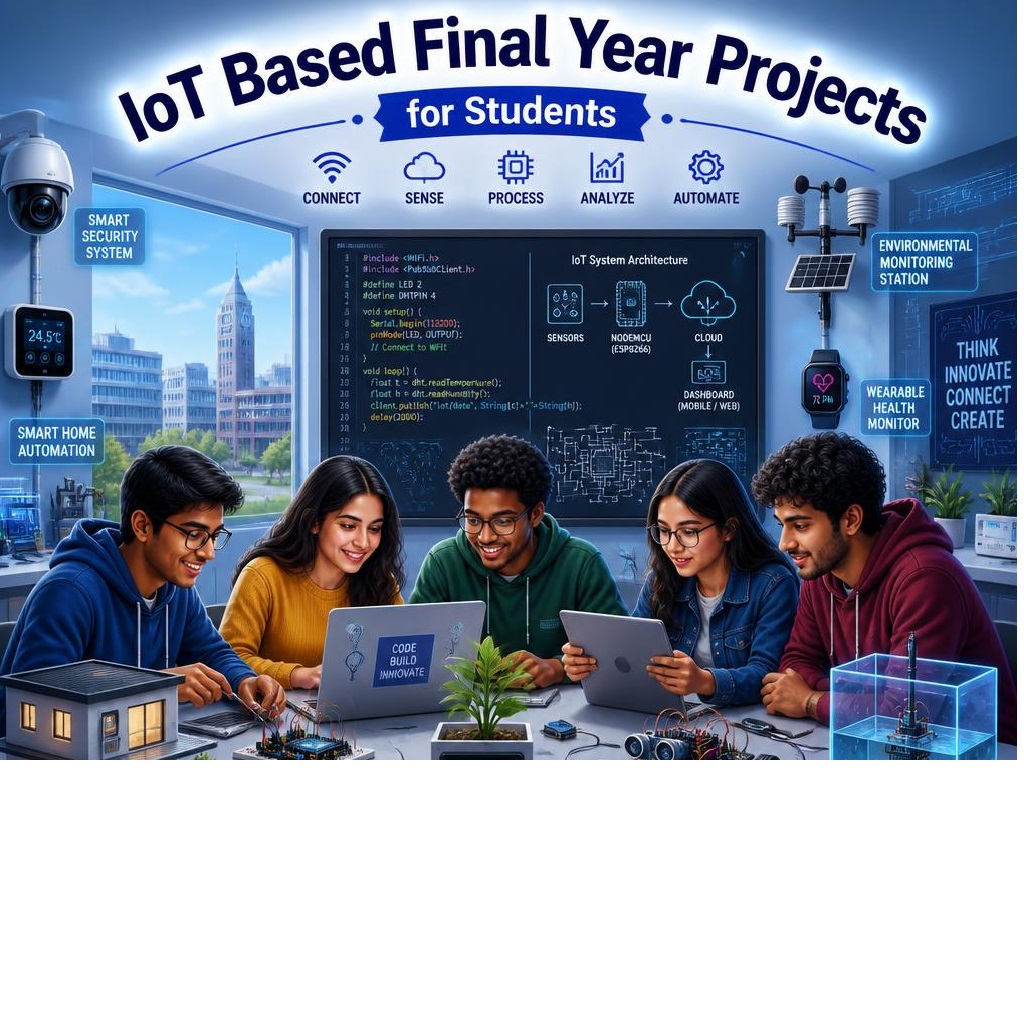
Top 10 IoT Final Year Projects: CS College/University FYP
Here is list of ideas/ Previous years' final-year projects of college/university
1. Intelligent Bug Hunting Platform Project
This project revolutionizes how software developers track bugs by combining ambient environmental monitoring with software development lifecycles (SDLC). It bridges physical workspace conditions with digital debugging efficiency.
The Core Concept:
An automated platform that tracks coding errors while simultaneously using IoT sensors to monitor the developer’s environment (temperature, humidity, and posture).
System Architecture:
Edge Layer: Environmental sensors collect workspace metrics.
Processing Layer: Microcontroller packages data and updates a local OLED screen.
Cloud Layer: Data is pushed via MQTT to a central Django server that maps bugs against environmental stressors.
Hardware Required: ESP32 Wi-Fi module, DHT11 environmental sensor, MPU6050 posture sensor, and an OLED display.
Software Stack: Python, Flask/Django framework, SQLite database, and MQTT protocol.
Step-by-Step Implementation:
- Wire the DHT11 and MPU6050 sensors to the ESP32 pins.
- Write firmware to read climate metrics and track angular deviation for posture monitoring.
- Set up an MQTT broker (like Mosquitto) to receive JSON payloads from the hardware.
- Build a Python Django dashboard that correlates IDE bug logs with the environment timeline.
2. IoT-Based Smart Parking Locator with Google Maps Integration
Urban traffic congestion is a massive global issue. This college final-year project addresses the problem by creating a live, cloud-connected parking infrastructure mapping system.
The Core Concept:
Smart sensors detect parking spot occupancy in real-time and broadcast the availability directly onto a custom web and mobile map interface.
System Architecture:
Sensing Node: Proximity sensors installed at each parking slot detect vehicle presence.
Gateway Layer: Nodes send status updates to a Firebase database instantly.
User Interface: Mobile applications fetch coordinates and slot statuses to display live maps.
Hardware Required:
NodeMCU (ESP8266), ultrasonic sensors (HC-SR04), infrared (IR) sensors, and a servo motor for the smart gate mechanism.
Software Stack:
Flutter/React Native for the app, Node.js backend, Firebase Realtime Database, and Google Maps SDK.
Step-by-Step Implementation:
- Position ultrasonic sensors over designated mock parking slots to calculate distance variations.
- Program the NodeMCU to upload a binary state (0 for empty, 1 for occupied) to Firebase.
- Connect the Google Maps API with a mobile frontend app to show geo-fenced coordinates.
- Implement a servo-motor logic circuit that opens the entry gate only when free spaces remain.
3. Real-Time University Transit Tracker System
Navigating campus shuttle schedules can be chaotic for college students. This transit tracking system brings fleet management technology directly to the university ecosystem.
The Core Concept:
A compact IoT tracker placed inside university buses transmits live location coordinates to a centralized server, allowing students to see exactly when their ride arrives.
System Architecture:
GPS Node: Hardware modules in moving shuttles compute telemetry data continuously.
Communication Link: Cellular or high-range Wi-Fi boards forward coordinates to web servers via WebSockets.
Client Interface: Students look at a lightweight web map with live-updating bus icons.
Hardware Required:
Neo-6M GPS module, GSM/GPRS module (SIM800L) or ESP32, and an Arduino Uno.
Software Stack:
Leaflet.js or Google Maps API, WebSockets (Socket.io), Node.js, and MongoDB for historical route logs.
Step-by-Step Implementation:
- Interface the Neo-6M GPS module with the microcontroller to parse NMEA sentences.
- Configure the communication module to open persistent TCP sockets with your backend server.
- Program the Node.js backend to broadcast incoming coordinate pairs to all connected web clients.
- Build a Leaflet.js frontend dashboard showing smooth tracking markers moving across campus maps.
4. Smart Plant Care System with AI-Based Monitoring and Mobile App
Smart agriculture and automated home gardening are incredibly popular topics for computer science final year projects. This project fuses IoT automation with artificial intelligence to optimize plant health.
The Core Concept:
Soil and environmental sensors constantly track plant vitals, while an onboard camera uses AI to detect early signs of plant leaf diseases.
System Architecture:
Data Collection Node: Sensors measure chemical and physical changes in soil matrixes.
Computer Vision Edge Node: Camera modules capture leaf patterns periodically.
Automation Layer: Relays actuate mechanical pumps based on moisture deficits.
Hardware Required:
Raspberry Pi (or ESP32 Cam), soil moisture sensor, LDR (light-dependent resistor), submersible 5V water pump, and a relay module.
Software Stack:
TensorFlow Lite (for edge AI disease detection), React Native, Firebase, and Python scripts.
Step-by-Step Implementation:
- Calibrate the soil moisture sensor to define dry and wet threshold voltages.
- Connect a 5V relay circuit to trigger the water pump when moisture levels drop below the threshold.
- Train a lightweight convolutional neural network (CNN) on plant leaf diseases using TensorFlow.
- Deploy the converted .tflite model on the Raspberry Pi to analyze live camera frames.
5. IoT-Powered Smart Grid and Home Energy Management System
With rising electricity costs worldwide, efficient energy distribution is a premier theme for a university final-year project. This system bridges macro-level power grid tracking with micro-level home appliance monitoring.
The Core Concept:
A non-invasive current and voltage sensor node tracks the power consumption of household appliances, uploads it to a cloud server, and allows users to remotely cut power to faulty devices.
System Architecture:
Sensing Subsystem: Current clamps sample electrical draw from main lines safely.
Relay Control Matrix: Microcontrollers control automated switches to isolate specific circuits.
Visualization Cloud: An interactive dashboard calculates trends, consumption anomalies, and pricing.
Hardware Required:
Arduino Nano, SCT-013 Current Sensor, ZMPT101B Voltage Sensor, ESP8266 Wi-Fi Module, and solid-state relays.
Software Stack:
ThingsBoard IoT Platform, HTML5/CSS3 dashboard, MySQL, and Python scripts for data crunching.
Step-by-Step Implementation:
- Attach the non-invasive SCT-013 current sensor to an isolated appliance phase wire.
- Write an Arduino script using the EmonLib library to calculate root-mean-square (RMS) current.
- Set up the ESP8266 to transmit data blocks to a ThingsBoard dashboard via HTTP POST requests.
- Design logic parameters on the dashboard to trigger relays when power draws exceed safety thresholds.
6. Wearable IoT Health Monitoring System for Remote Patient Care
Healthcare technology remains one of the highest-paying niches for Google AdSense ad revenue. This college final-year project addresses the critical need for continuous health tracking without hospital confinement.
The Core Concept:
A compact, wearable wristband that reads vitals simultaneously and transmits them via Bluetooth or Wi-Fi to a doctor’s live monitoring portal.
System Architecture:
Wearable Unit: Ultra-low power biosensors record patient cardiovascular data.
Alert Framework: Cloud scripts process streams to flag abnormal spikes instantly.
Medical Console: A secure panel where medical practitioners review patient vitals remotely.
Hardware Required:
ESP32 NodeMCU, MAX30102 Pulse Oximeter, MPU6050 Gyroscope/Accelerometer sensor, and a lithium-polymer battery pack.
Software Stack:
Flutter framework for cross-platform apps, Firebase Realtime Database, Twilio API for emergency SMS, and Node-RED for hospital dashboards.
Step-by-Step Implementation:
- Connect the MAX30102 biometric sensor over the I2C communication protocol to your ESP32.
- Write a mathematical filter to remove physical movement noise from raw heart rate readings.
- Setup threshold conditions for fall detection using the acceleration vector fields from the MPU6050.
- Integrate the Twilio REST API within Firebase Cloud Functions to launch automated text alerts upon emergencies.
7. Automated Smart Warehouse Management System Using RFID and IoT
Logistics and supply-chain automation are ideal for computer science final year projects targeting enterprise-level problems. This project modernizes warehouse inventory workflows.
The Core Concept:
Goods equipped with RFID tags are read automatically when moving past entrance portals, instantly updating inventory levels on a central server without human manual scanning.
System Architecture:
Scanning Portals: Stationary reader units scan incoming passive tags continuously.
Central Database: A transaction broker tracks item counts, updates logs, and flags discrepancies.
Display Nodes: Visual terminals show stock statuses directly on warehouse floors.
Hardware Required:
Raspberry Pi 4, MFRC522 RFID reader module, passive RFID tags/stickers, and HC-SR04 ultrasonic sensors for shelf spacing.
Software Stack:
Django backend web framework, PostgreSQL database, React.js frontend interface, and MQTT data communication protocol.
Step-by-Step Implementation:
- Interface the MFRC522 SPI pins with the Raspberry Pi GPIO breakout grid.
- Design a PostgreSQL table system that maps unique RFID hex strings to product descriptions.
- Implement a backend routine that increments or decrements counts when tags trigger the portal sensors.
- Install ultrasonic sensors on storage racks to double-check physical space vs. digital inventory records.
8. IoT-Based Air Quality Index (AQI) and Noise Pollution Monitoring Station
Environmental engineering projects are heavily favored by university evaluation boards. This station maps urban environmental health indicators in real-time.
The Core Concept:
A solar-powered, weather-proof outdoor station deployed in various campus zones to read carbon monoxide, particulate matter, and acoustic noise levels.
System Architecture:
Sensor Arrays: Multi-gas electrochemical probes register particulate matter concentration.
Telemetry Cluster: Low-power wide-area networking microchips transmit logs over distance.
Analytical Interface: Cloud visualization systems organize time-series data streams.
Hardware Required:
Arduino Mega 2560, MQ-135 gas sensor, Sharp GP2Y1010AU0F dust sensor, sound decibel meter sensor, and a TP4056 solar charger shield.
Software Stack:
InfluxDB time-series database, Grafana dashboards for rich visualizations, and PHP/Laravel for the management panel.
Step-by-Step Implementation:
- Assemble gas, dust, and acoustic noise sensors onto an analog input terminal block of the Arduino Mega.
- Code the conversion mathematical curves to transform raw analog voltages into official PPM and dBA units.
- Build a power budget using a small solar panel and a TP4056 LiPo battery management unit.
- Send time-stamped datasets directly to InfluxDB and create public widgets using Grafana panels.
9. Biometric Smart Door Lock with Remote Face Recognition and Cloud Logging
Home security is a classic but highly dynamic IoT-based final year project. This variant bypasses simple keypads to utilize edge-AI biometric validation.
The Core Concept:
A front-door security unit that scans faces, compares them to a secure local database, unlocks a magnetic latch, and logs every access attempt onto a secure cloud webpage.
System Architecture:
Biometric Terminal: An integrated camera module processes visual feeds at entrance points.
Local AI Evaluator: Facial feature vectors are computed on the fly to detect registered individuals.
Mechanical Output: A high-current relay commands physical locking systems based on matches.
Hardware Required:
ESP32-CAM module, FTDI USB-to-TTL programmer, MG996R High-Torque Servo Motor (or Solenoid Door Lock), and 12V external power supply.
Software Stack:
OpenCV Python library for facial recognition processing, Twilio SendGrid email API, and a React Native administrator app.
Step-by-Step Implementation:
- Flash the ESP32-CAM board using an external FTDI programmer chip.
- Build a local facial detection algorithm using Haar Cascades or Histogram of Oriented Gradients (HOG).
- Program the board to stream MJPEG video across your local subnet to a Python host controller.
- Wire a heavy-duty solenoid lock through an isolating transistor circuit to toggle the lock mechanism cleanly.
10. Automated Smart Aquaculture and Fish Farm Monitoring Network
Precision agriculture and aquaculture represent multi-billion-dollar modern fields. This final project automates aquatic environment stability for commercial hatcheries.
The Core Concept:
Submerged sensor probes sample water conditions continuously, regulating automated heating, filtration, and feeding modules dynamically without manual labor.
System Architecture:
Submerged Probe Cluster: Waterproof sensors collect chemistry logs from water bodies.
Automation Core: Microchip engines activate peripheral hardware switches dynamically.
Remote Oversight Dashboard: Cellular mobile apps allow supervisors to manage parameters manually.
Hardware Required:
NodeMCU ESP8266, DS18B20 Waterproof Temperature Sensor, Analog pH Sensor kit, 28BYJ-48 Stepper Motor (for food dispensing), and a 5V relay shield.
Software Stack:
Blynk IoT mobile platform integration, Node.js web server, and MongoDB for logging seasonal water shifts.
Step-by-Step Implementation:
- Submerge the waterproof DS18B20 sensor and calibrate the sensitive analog pH probe using buffer solutions.
- Write an ESP8266 script to package chemistry metrics every five minutes to minimize sensor corrosion.
- Design a mechanical fish food container that rotates a stepper motor axis at specific intervals.
- Connect the setup to a Blynk interface app to allow manual override buttons for instant pump control.
FAQ/Frequently Asked Questions of Students
What is the easiest IoT project for engineering students?
The Smart Parking Locator or Air Quality Monitoring Station is a perfect beginner option. They utilize basic analog/digital sensors and straightforward cloud links, making them excellent choices if you are new to hardware programming.
Which microcontrollers are best for a computer science final year project?
The ESP32 NodeMCU is highly recommended for modern projects. It features native Wi-Fi and Bluetooth chips, a dual-core processor, and plenty of GPIO pins at a very low cost. For projects requiring heavy on-edge processing like live video manipulation or machine learning models, choose a Raspberry Pi 4.
Can I build an IoT project without real physical hardware?
Yes, you can use online embedded systems simulators like Wokwi or Tinkercad to build and write code for your systems digitally. However, university panels always favor real hardware presentations over digital simulations during final grading exhibitions.